A game that sends you out into the real world, and quietly helps map it.
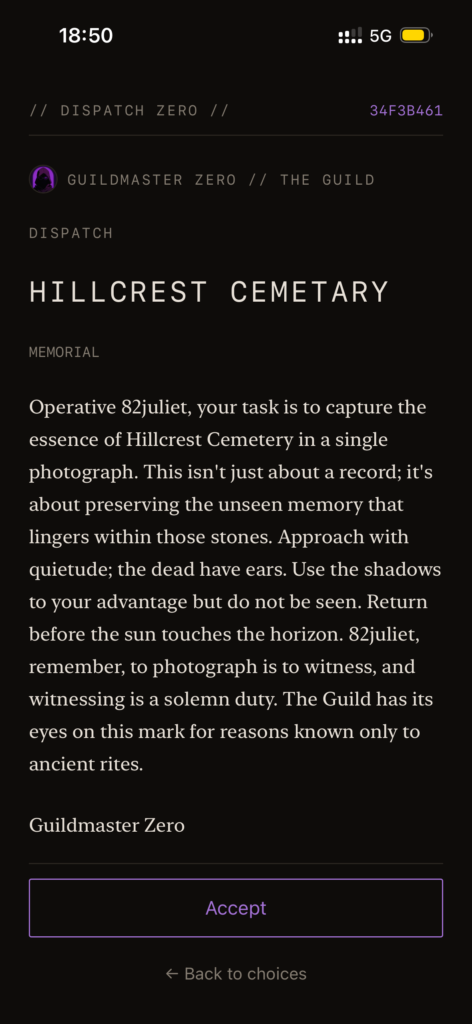
Here is the pitch. A handler named Zero radios you an assignment, points you at a real landmark somewhere near you, and sends you out to photograph it as proof you were there. Maybe it is a mural two streets over that you have walked past a hundred times. Maybe it is an old church at the edge of town, a war memorial in the park, or a statue you never stopped to read. You get a briefing dripping with intrigue, you go, you take the shot, and the run gets stamped into your permanent dossier. Think Carmen Sandiego meets Pokemon Go, except every target is a real place you can actually stand in front of.
It is three things at once. It is a game, with ranks to climb, badges to collect, and a handler whose voice you get to choose. It is a reason to look up, to take the long way home and actually notice the place you live in. And it is a chance to give back. Spot a place the map is missing and you can flag it for addition to Dispatch Zero. Each one is reviewed by hand, and locations of exceptional quality may even earn a place on OpenStreetMap, the free, community-built map of the world that help power our system.
Best of all, there is nothing to buy and nothing to install from an app store. It runs right in your phone’s browser, there is no account email, and the whole thing is open source from top to bottom. This post walks you through all of it: signing up, adding it to your home screen, completing your first dispatch, and helping build the map as you go.
What you need
- A phone with a web browser (iPhone or Android both work).
- A willingness to walk a few blocks.
- That is it. The game is free, with no ads and no trackers.
Step 1: Apply for field status
Open dispatchzero.ataary.com in your phone’s browser and tap Apply for Field Status. You will set three things:
- A callsign. Your operative name (letters, numbers, dashes, and underscores). It appears on every mission card you earn.
- A passphrase. Pick something you will remember. Important: there is no email on file and no password reset. No replacements are issued, so memorize what you set.
- An organization. The same handler, Zero, in three very different voices:
- The Archive (Professor Zero): warm, curious, expedition energy.
- The Agency (Director Zero): cold, classified, professional.
- The Guild (Guildmaster Zero): ancient, ceremonial, formal.
Choose whichever voice sounds the most fun. You can switch organizations anytime in Settings, so nothing here is locked in except your callsign.
Step 2: Add it to your home screen
Dispatch Zero is a web app you can install straight from the browser, no app store required. Once installed it opens full screen with its own icon, no browser bars in the way.
On iPhone (Safari):
- Open dispatchzero.ataary.com in Safari.
- Tap the Share button (the square with an arrow pointing up).
- Scroll down and tap Add to Home Screen.
- Tap Add. The Dispatch Zero icon now lives on your home screen.
On Android (Chrome):
- Open the site in Chrome.
- Tap the three-dot menu in the top right.
- Tap Add to Home screen (or Install app).
- Confirm. The icon now lives on your home screen.
From here on, launch it from that icon like any other app.
Step 3: Run your first dispatch
- Tap Request Dispatch. Zero scans for real landmarks near you and offers you three targets to choose from.
- Pick the one you like. You will get a short briefing in your organization’s voice, telling you where you are headed and why (in character, with a bit of mystery).
- Tap Accept and start walking.
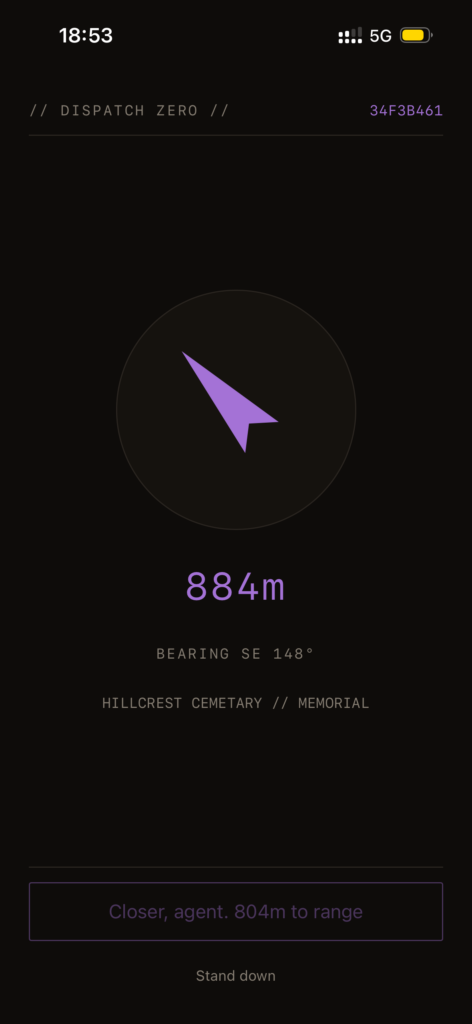
- Tap the compass to enable a guide pointing to your dispatch location.
- When you get within about 80 meters of the target, the camera unlocks. Take a photo of the place as your proof.
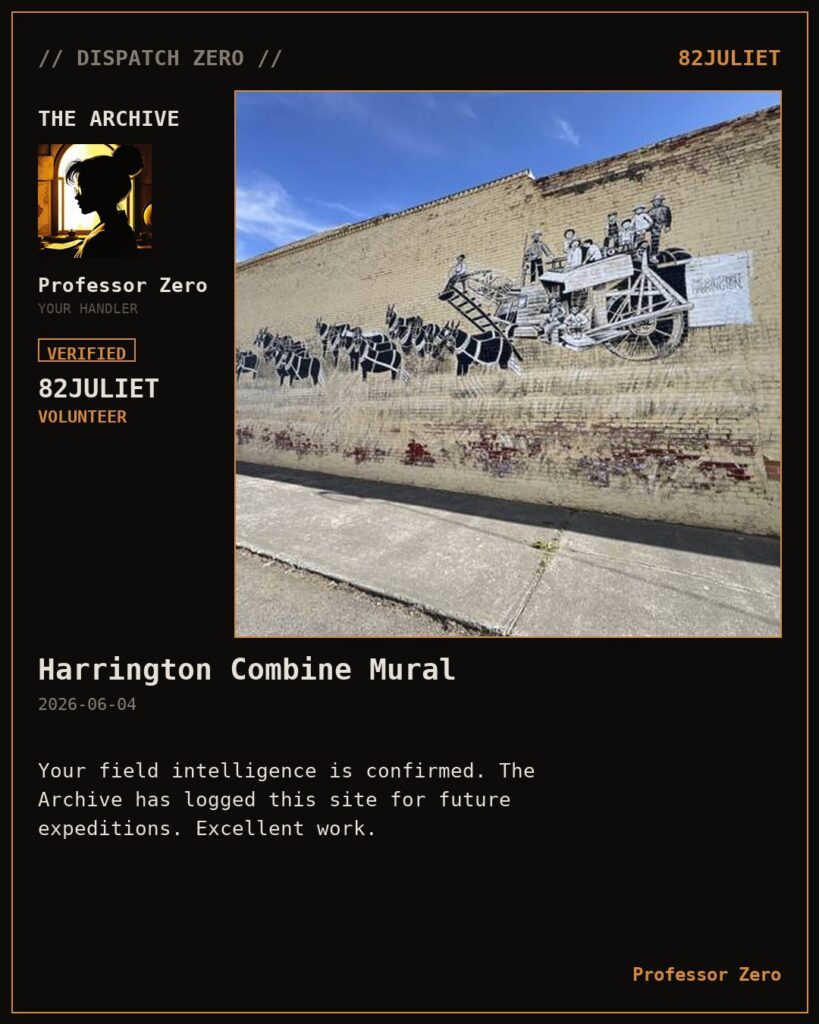
- The app confirms you are on site and that the shot is fresh, then composes a 4:5 mission card with your callsign, rank, and the place.
- Rate your mission and grab a share link for your mission card. Then it is logged to your dossier.
Two things keep verification smooth:
- Allow location access when your browser asks. The game uses your location to confirm you reached the target.
- Take the photo on the spot, with the app’s camera. It checks that the shot is recent, so an old picture from your camera roll will not pass.
Ranks, badges, and your dossier
Every completed mission raises your standing, and each organization has its own ladder of titles. The Archive runs from Volunteer up to Antiquarian, The Agency from Intern up to Officer, The Guild from Aspirant up to Magister. You also earn badges for the kinds of places you photograph and for keeping a steady cadence. Your dossier keeps every mission card, and each one has a share link if you want to show it off.
Found a place that is not on the map? Report it
Out in the field you will eventually spot something worth documenting that the map does not know about: a mural, a memorial, an old church in the middle of nowhere. Tap Report, add a photo, a name, and a category, and send it in. From there it enters a review queue, where a maintainer checks it against the existing map before anything is published. Submissions that hold up can become missions for other players, and a verified few are published to OpenStreetMap under a dedicated project account, with the photo’s location and a note on where the data came from. Nothing is added to the map automatically, and not every report makes it. The ones that do are a small, genuine contribution to a map the whole world shares.
Built in the open
Dispatch Zero is open source, top to bottom, and it runs on open tools. It finds places using OpenStreetMap, Wikipedia, and Wikidata, and the briefings are written by OLMo 2, an open-weights AI model from the Allen Institute for AI. No trackers, no ads, no analytics watching you.
The whole project is released under the GNU AGPL-3.0 license, and the full source code lives on GitHub. You are welcome to read it, run your own copy, or build on it. And the places you help add flow back into the same open map the game reads from, so the whole thing gets better the more people play.
Want the story behind the game and its updates? There is more here.
That is the full briefing, operative. Your first dispatch is waiting.